

Syrian Jews Share Muslims’ Iftar Joy in Damascus During Ramadan Needy families receive Ramadan support as a small remaining Jewish community highlights longstanding ties with Muslim neighbors By Rizik Alabi / The Media Line [DAMASCUS] The Syrian Mosaic Foundation, a Jewish organization, recently visited Lala Pasha Mosque in Damascus to donate meat for iftar meals […]
Religious News
The Media Line: Syrian Jews Share Muslims’ Iftar Joy in Damascus During Ramadan

Audio By Carbonatix
Syrian Jews Share Muslims’ Iftar Joy in Damascus During Ramadan
Needy families receive Ramadan support as a small remaining Jewish community highlights longstanding ties with Muslim neighbors
By Rizik Alabi / The Media Line
[DAMASCUS] The Syrian Mosaic Foundation, a Jewish organization, recently visited Lala Pasha Mosque in Damascus to donate meat for iftar meals during the holy month of Ramadan. The effort aimed to support needy families and strengthen social ties among the various communities in Syrian society.
Joe Jajati, a Syrian Jew living in the United States and a member of the foundation, told The Media Line that the initiative reflects Syrian Jews’ commitment to contributing to daily life in society, including sharing with Muslims the joy of fasting, as well as the spirit of solidarity that characterizes this holy month.
Jajati explained that this initiative is not merely an act of charity but reflects a broader vision based on strengthening unity among the different components of Syrian society. Damascus, with its ancient history and diverse cultural heritage, is a true mosaic of the Syrian people, where different cultures and religions converge.
In this context, the foundation said that donating during Ramadan represents an opportunity to embody the values of mutual respect and cooperation between Jews and Muslims, and to remind everyone of the shared heritage that has united them over the centuries.
Foundation officials said that providing meat and iftar meals carries a profound humanitarian message, reflecting the concern of the Syrian Jewish community for supporting impoverished families and society as a whole.
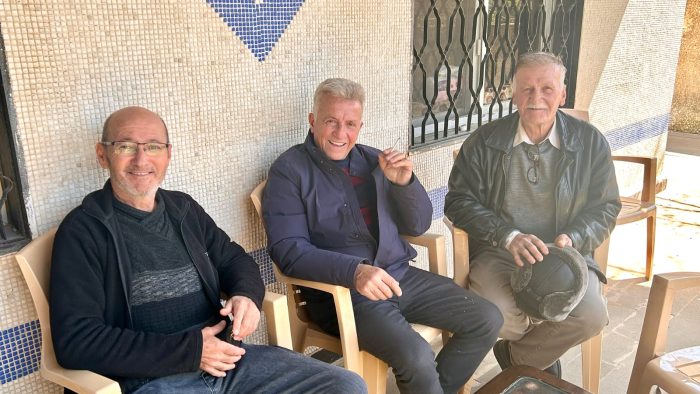
Bakhour Chamntoub, spokesperson for the Jewish community in Damascus, told The Media Line that this effort reflects the authentic coexistence between the Jews of Damascus and other communities. “This is the Damascus we know, and that knows us,” he said.
Residents who benefited from the initiative expressed deep appreciation for the Syrian Mosaic Foundation’s efforts. They said that Syrian Jews’ participation during Ramadan adds a special dimension to residents’ joy and sense of wellbeing at iftar, while praising community and cultural institutions for strengthening solidarity among diverse groups through shared human values that transcend religious and social differences.
Through this initiative, the foundation aims to ease citizens’ day-to-day burdens during Ramadan and enhance their sense of peace of mind and joy during this important spiritual and social period.
Syrian Jews sharing Muslims’ joy in fasting is not merely a material gesture but an expression of mutual respect and a desire to strengthen understanding and unity among the different components of society.
According to the foundation, activities during Ramadan are part of a series of initiatives it implements throughout the year to support the local community through education, humanitarian work, and culture, with the aim of strengthening
the spirit of good citizenship and elevating cooperation among all segments of society.
The foundation emphasized that Jewish participation in this Ramadan activity is not only a humanitarian duty but also a symbolic message of coexistence, tolerance, and national unity, embodying the way Syrian society can combine religious diversity with social harmony. It described the initiative as a living model of cooperation between Jews and Muslims in Damascus, reflecting the ability of community institutions to strengthen human bonds and promote values of respect and compassion among different communities.
Charitable work during the month of Ramadan carries special symbolism, reflecting values of tolerance, cooperation, and sharing—values deeply rooted in Syria’s diverse heritage.
Jews in Syria have a long and ancient history spanning thousands of years, with a continuous presence in cities such as Damascus, Aleppo, Homs, and Latakia. The Jewish community in Damascus is believed to date back to the Persian and Roman eras and was an integral part of the city’s social, economic, and cultural fabric.
Historically, Damascus included distinct Jewish neighborhoods such as the Jewish Quarter near the Old City, where the Jewish community lived side by side with Muslims and Christians. Syrian Jews preserved the Arabic language and their own dialect, in addition to using Hebrew in synagogues and religious schools, reflecting their cultural integration into Syrian society. They also contributed to cultural and artistic life by participating in folk arts, music, and heritage, making them an integral part of the Syrian cultural mosaic.
During the 20th century, the Jewish community was affected by political and social transformations in Syria, and a large portion emigrated abroad. Some families, though, remained, preserving their heritage and relationships with the local community and continuing to play a symbolic role in promoting coexistence among religions. The memory of Jews in Damascus remains present through historical buildings such as ancient synagogues, religious schools, and traditional craft markets, reflecting a long history of religious diversity and cooperation among different parts of society.
Today, initiatives such as the visit by the Syrian Mosaic Foundation contribute to strengthening this shared heritage and reviving the spirit of coexistence between Jews and Muslims, especially during religious occasions such as Ramadan. Damascus has been, and continues to be, a city of multiple cultures and religions, where different communities share in celebrating spiritual and social occasions and build bridges of respect and cooperation across generations.
PHOTO- Syrian Jewish community leader Bakhour Chamntoub (C), with participants in the event. (The Media Line)