

By Laila Bassam, Tom Perry, Samia Nakhoul and Maya Gebeily BEIRUT, March 21 (Reuters) – Iran’s Revolutionary Guards (IRGC) rebuilt Hezbollah’s military command after it was mauled by Israel in 2024, plugging gaps with Iranian officers before restructuring the Lebanese group and laying plans for the war it is now waging in support of Tehran, […]
World
How Iran’s IRGC rebooted Lebanon’s Hezbollah to be ready for war

Audio By Carbonatix
By Laila Bassam, Tom Perry, Samia Nakhoul and Maya Gebeily
BEIRUT, March 21 (Reuters) – Iran’s Revolutionary Guards (IRGC) rebuilt Hezbollah’s military command after it was mauled by Israel in 2024, plugging gaps with Iranian officers before restructuring the Lebanese group and laying plans for the war it is now waging in support of Tehran, two people familiar with these IRGC activities said.
The overhaul was the first of its kind for Hezbollah, a Shi’ite Muslim group founded by the IRGC in 1982, pointing to a hands-on approach after the blows of the 2024 war, including the killing of its leader Hassan Nasrallah and other top commanders.
Iran’s investment paid off, getting Hezbollah back on its feet in time to enter the war in the Middle East on Tehran’s side after it was attacked by the United States and Israel.
Reuters reported earlier in March that Hezbollah had seen another war as inevitable and spent months readying itself. This article sheds light on the IRGC’s role in these preparations, based on accounts from six sources who spoke on condition of anonymity as well as an expert on Hezbollah.
The IRGC, deeply involved in Hezbollah since it was established, sent officers to retrain its fighters and oversee rearmament, the two sources familiar with IRGC activities said.
They said IRGC officers also reshaped Hezbollah command structures that had been breached by Israeli intelligence – a factor that had helped Israel kill many Hezbollah leaders.
An Israeli military spokesperson said on March 12 that Hezbollah remains a relevant and dangerous force despite the damage Israel has inflicted on it over the last three years.
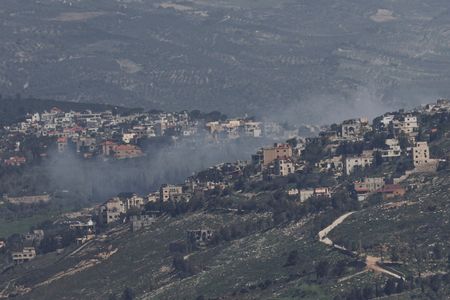
Hezbollah has fired hundreds of missiles at Israel since it entered the regional war on March 2, prompting an Israeli offensive that has killed more than 1,000 people in Lebanon. Hezbollah fighters are battling Israeli soldiers who have seized ground in the south.
It has yet to be seen how Hezbollah, its power still below the peak levels seen a few years ago, would fare in the event of a full-scale Israeli invasion.
Hezbollah’s media office, Iran’s Foreign Ministry and Israeli Prime Minister Benjamin Netanyahu’s office did not immediately respond to requests for comment.
Netanyahu said in January that Hezbollah was making efforts to rearm and rebuild its infrastructure with Iranian support.
SCRAPPING HIERARCHY
The two sources said IRGC officers tasked with helping Hezbollah recover arrived shortly after a ceasefire in November 2024, and set to work even as Israel continued to strike.
One of them said the deployment involved about 100 officers.
Changes implemented at their behest included replacing a hierarchical command structure with a decentralised one, comprising small units with limited knowledge of each other’s operations, helping to preserve operational secrecy.
They said IRGC officers also drew up plans for missile attacks against Israel that would be launched simultaneously from Iran and Lebanon – a scenario executed for the first time on March 11.
A senior Lebanese security source said Iranian commanders had helped Hezbollah rehabilitate and reorganize their military cadres. The source said he believed the Iranians were helping Hezbollah pace the current conflict rather than being involved in the detail of picking targets.
Another source briefed on the matter said the IRGC sent officers to Lebanon in 2024 to conduct a post-war audit of Hezbollah, and took direct supervision of its military wing.
An additional two sources said the IRGC had embedded special advisers with Hezbollah last year to help it direct military affairs.
Andreas Krieg, a lecturer at the security studies department of King’s College London, said the IRGC “has basically reorganized Hezbollah as a far more flat system”, contrasting this with the political hierarchy that had emerged around Nasrallah before his death.
“That decentralized model that they’ve now implemented is also a bit more like what Hezbollah looked like in the 1980s – very small cells,” said Krieg, who has researched the group for 15 years. He described this as a “mosaic defence” that is also being used by the IRGC in Iran.
LEBANON ASKED IRGC TO LEAVE COUNTRY
The IRGC’s efforts were going on at the same time as Lebanon’s government and its U.S.-backed military were seeking to advance a process to disarm the group, underscoring a huge complication facing that objective.
Lebanon estimates that around 100 to 150 Iranian nationals in the country have ties to the Iranian government that go beyond normal diplomatic functions, including links to the IRGC, a Lebanese official told Reuters.
The official said the government asked those people to leave Lebanon in early March.
The two sources familiar with IRGC activities said Guards officers were among more than 150 Iranians who left Beirut on a flight to Russia on March 7.
IRGC members were among the roughly 500 people killed by Israeli attacks in Lebanon in the 15 months between the 2024 ceasefire and the eruption of the new war.
Around a dozen more have been killed in Israeli attacks since the war erupted, including in a strike on a Beirut hotel on March 8, they said.
The IRGC has been closely involved in Hezbollah since its men established the group in the eastern Bekaa Valley to export Iran’s 1979 Islamic Revolution and fight Israeli forces that had invaded Lebanon in 1982.
Qassem Soleimani, the top IRGC general who was killed in 2020 by a U.S. drone strike, had worked alongside Nasrallah during Hezbollah’s 2006 war with Israel. When Israeli airstrikes killed Nasrallah in a bunker in Beirut’s southern suburbs, an Iranian general was among those who died alongside him.
(Additional reporting by Alexander Cornwell in JerusalemWriting by Tom PerryEditing by Gareth Jones)