
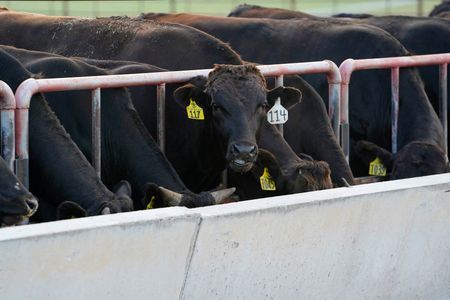

By Renju Jose and Peter Hobson SYDNEY/CANBERRA (Reuters) -Australia will ease restrictions on beef imports from the United States, the country’s agriculture ministry said on Thursday, potentially smoothing trade talks with U.S. President Donald Trump, who had attacked its rules. Still, the decision is unlikely to significantly boost U.S. shipments because beef prices are much […]
Business
Australia relaxes curbs on US beef that angered Trump

Audio By Carbonatix
By Renju Jose and Peter Hobson
SYDNEY/CANBERRA (Reuters) -Australia will ease restrictions on beef imports from the United States, the country’s agriculture ministry said on Thursday, potentially smoothing trade talks with U.S. President Donald Trump, who had attacked its rules.
Still, the decision is unlikely to significantly boost U.S. shipments because beef prices are much lower in Australia, analysts said.
Agriculture Minister Julie Collins said in a statement a “rigorous science and risk-based assessment” had concluded that U.S. measures to monitor and control the movement of cattle meant biosecurity risks were being effectively managed.
The government “will never compromise on biosecurity,” she said, adding: “Australia stands for open and fair trade – our cattle industry has significantly benefited from this.”
Canberra has restricted U.S. beef imports since 2003 due to concerns about bovine spongiform encephalopathy (BSE), or mad cow disease.
Meat from animals born, raised and slaughtered in the U.S. has been allowed into Australia since 2019. But few suppliers were able to prove their animals had been only in the U.S., because cattle frequently moved between the U.S., Canada and Mexico without being adequately tracked.
The U.S. has been improving its ability to monitor animals’ movements to limit the spread of avian influenza and the New World screwworm, a parasite that eats cattle alive.
Recognising those improvements, Australia will now also accept beef sourced from cattle born in Canada or Mexico and legally imported and slaughtered in the U.S., the agriculture ministry said.
Australian firms will be able to apply for import permits from July 28, it added.
ALMOST DOUBLE
News of Australia changing its policy was first reported by the Australian Financial Review. The report said Australia will use the easing of rules to argue its case for the United States to wind back 50% tariffs on steel and aluminium and Trump’s threat to impose a 200% tariff on pharmaceuticals.
Trump in April singled out the beef trade disparity with Australia after Australia’s beef exports to the United States surged last year, reaching A$4 billion ($2.64 billion) amid a slump in U.S. beef production.
Australia’s biosecurity regimen aims to keep its cattle disease-free and help it preserve access to lucrative markets such as Japan and South Korea.
U.S. beef shipments to Australia restarted last year after a hiatus.
But exports remained tiny. Last year’s shipment of 269 tons of beef to Australia was the most for any year, beating out the 263 tons sent in 1995, Australian customs data show.
Australia has shipped between around 150,000 tons and 400,000 tons of beef every year to the U.S. since 1990, with U.S. fast-food chains prizing Australian product for its lower fat content and competitive prices.
Cattle prices in the United States are almost always higher than in Australia and are currently double Australian levels, said Matt Dalgleish, a meat and livestock analyst at consultants Episode 3.
“This is not going to displace Australian beef in the Australian market,” he said.
(Reporting by Renju Jose in Sydney and Peter Hobson in Canberra; Editing by Jamie Freed, Rod Nickel and Christian Schmollinger)